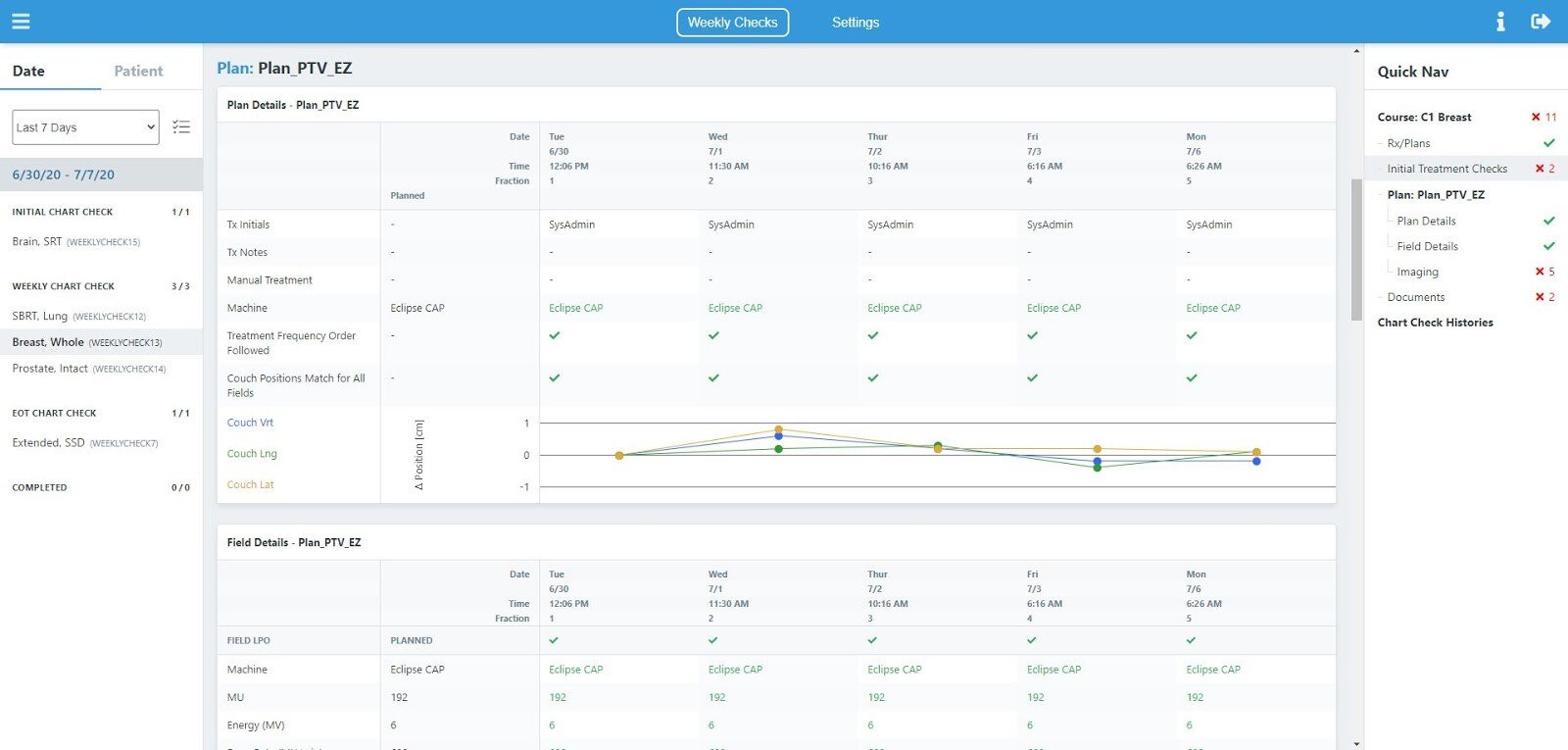
Automate TG-275 Plan Checks with
ClearCheck & ChartCheck
Effortless Compliance in One Click
TG-275 plan checks, simplified. ClearCheck automates key checks like dose constraints, structure integrity, and collision detection, while ChartCheck supports post-treatment plan checks, making compliance with TG-275 fast and efficient. See how both tools automate TG-275 requirements to improve safety and streamline your plan review workflow.
Explore Our Features
ClearCheck
ChartCheck
ClearCheck
ChartCheck
Patient Assessment
Prescription approval by attending radiation oncologist
-
Special considerations for radiotherapy (e.g. pacemakers, ICDs, pumps, etc.)
Previous radiotherapy treatments
Peer review of treatment decision (e.g. tumor board, peer-to-peer evaluation, etc.)
Simulation
Isocenter placement
Isocenter consistency between patient marking and setup instructions
CT scanning range
Consistency between orientation of image on the CT scan and treatment plan
Motion Management Techniques Process
Breath-hold parameters and data set
Gating parameters
Contouring Checks
Target(s)
Organs-at-risk (OAR’s)
Body/external contour (if required/applicable)
PTV and OAR margin
Structures used during optimization
Contours density override
Supporting structures (i.e. couch, immobilization and ancillary devices, etc.)
Prescription checks (physician intent/Rx vs. treatment plan)
Site
Laterality
Energy
Bolus
Dose/fraction
Number of fractions
Additional shielding
Modality (e.g. electrons, photons, protons, etc.)
Technique (e.g. 3D, IMRT, VMAT, SBRT, etc.)
Isocenter Checks
Additional shifts
Multiple isocenters
Optimization or Calc Parameters Checks
Target planning objectives
Organs-at-risk planning objectives
Normalization
Calculation algorithm
Calculation grid size
Density override
Dose Distribution and Overall Quality of The Plan
DVH statistics
Target Coverage
Sparing of OARs
Dose distribution
Hot spots
Plan sum (e.g. original plus boost plans)
Standard Operating Procedures of Practice Followed
Beam deliverability
Treatment technique (e.g. 3D, IMRT, VMAT, SBRT, etc.)
Field ID or name
Course and plan ID
Delivery system (e.g. linac or other specialized unit)
Beam modifiers (e.g. wedges, electron and photon blocks, tray, etc.)
MU
Energy
Dose rate
Field size
Field aperture
Tolerance table
Field delivery times
Bolus utilization
Collision
Setup shifts
Treatment couch model
Reference points
Dose tracking
Dose breakpoints
Treatment plan warnings/errors
Data Transfer From TPS to 3rd Party OIS
Field ID or name
Dose/fraction
Number of fractions
Treatment machine
Beam arrangement
Energy
MU
Gantry
Collimator
Field size
MLC control points
Beam modifiers (e.g. wedges, electron and photon blocks, tray, etc.)
Couch parameters
Isocenter
Setup For Image-Guidance
DRR association
Reference image (2D or 3D) isocenter
Imaging technique
Verify Treatment Plan on New CT
Isocenter placement
Deformed or new contours
DVH comparison
CTV/PTV coverage
Organs at risk dose limits
Additional Initial Plan Checks
Approval of physician intent/prescription
Verification plan for patient specific QA measurement
Final plan and prescription approval by physician
Documentation and Communication
Modification of prescription or plan
Prescription matches plan
Treatment technique (e.g. IMRT, VMAT, 3D conformal, etc.)*
Beam modifier (e.g. wedges, electron and photon blocks, tray, etc.)*
Plan parameter override (especially dose and/or MU and no documentation)*
Dose limit override (no documentation)*
Couch position (vertical/lateral/longitudinal/rotational)*
Couch position acquired at time of verification*
Setup instructions (review for incorrect, unclear or insufficient documentation pertaining to laterality and site; multiple site cases; missing setup images; changes in script; bolus terminated)^
Correct fields treated (especially in cases with prior treatment that was incomplete; boost started early; resimulation ordered)
Treatment Progression
Fraction treated (review all fields were treated for a given treatment site, especially in cases with prior treatment that was incomplete; boost started early; resimulation ordered)*
Dose tracking*
Partial treatments*
Changes in treatment field parameters*
Treatment sessions remaining (verify treatments delivered match treatment sessions and review notes for missed sessions)*
Unexpected breaks in treatments*
Treatments completed out of clinical mode*
In vivo dosimetry (not performed, especially in the case of cardiac devices)
Treatment sequence (e.g. first plan followed by boost, etc)*
Treatment regimen (e.g. BID, Quad Shot, etc.)*
Image Guidance
Images approved (as per department policy, especially pre-treatment imaging)*
Shifts applied*
Image technique prescribe by MD is followed (e.g. CBCT, 2D kV, 2D MV)*
Isocenter on DRRs match plan^
High-risk Failure Modes in EOT Chart Review for EBRT
End-of-Treatment Summary present*
All documents approved*
Course completed (Verify all treatments were delivered as prescribed) OR treatment stopped or cancelled (verify accurate documentation)*
All physics tasks completed*
Review any treatments delivered out of clinical mode
Documented plan matches the prescription and the chart, including changes and revisions (total number of fractions and dose delivered)
All images approved*
Ready to learn more?
CASE STUDY
READ THE CASE STUDY
Enhancing Efficiency and Collaboration in Plan Evaluation: A ClearCheck Implementation Case Study
University Hospital Würzburg implemented ClearCheck to improve efficiency and accuracy in patient treatment plans, reducing manual reporting time and enhancing analysis of over 2,000 plans.
BLOG
READ THE FULL BLOG
Implementing TG-275 with ChartCheck
BLOG
READ THE FULL BLOG